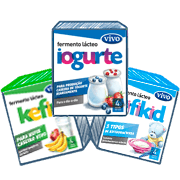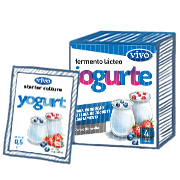
VIVO starter culture contains beneficial bacteria. These bacteria have several properties:
- They can ferment milk, turning it into a fermented dairy product.
- They have probiotic properties and help restore the intestinal microflora.
- They inhibit the growth of many harmful microorganisms.
VIVO starter cultures are used to make fermented dairy products. Homemade products made with VIVO starter cultures have several potential health benefits and advantages over store-bought yogurts.
Fermented dairy products made with VIVO starter cultures can be used:
- As an alternative to store-bought yogurt, cottage cheese, or sour cream in everyday meals.
- To help support and maintain a healthy gut microbiota.
- To help support gut health during and after antibiotic treatment.
- As fermented dairy foods for children aged 2 and older.
- To support immune health.
- As part of a balanced diet.
A common way to help restore the gut microbiota is to use probiotics: products containing beneficial bacteria.
Unlike pills, VIVO fermented dairy products provide beneficial bacteria to the gut in the form of food.
Another difference is the number of beneficial bacteria. According to the source text, the number of bacteria in an average capsule or pill is comparable to the number in one gram of a VIVO product.
When the gut microbiota is disrupted, harmful or potentially harmful microorganisms may increase. VIVO fermented dairy products contain bacteria that can inhibit the growth of certain harmful microorganisms.
During fermentation, these bacteria produce lactic acid and other substances that can inhibit the growth of certain harmful bacteria and fungi.
Starter cultures differ in the types of bacteria they contain. These differences affect:
- Preparation time and temperature.
- The taste and texture of the finished product.
- The product’s dietary and potential health benefits.
- The type of finished product, such as kefir or yogurt.
More information about starter cultures is available in the product catalog.
The VIVO group of companies was established in 2008 and specializes in producing and selling bacterial starter cultures for making fermented dairy products at home.
Thanks to their distinctive properties, quality, and safety, VIVO starter cultures are used by millions of people around the world.
VIVO starter cultures are widely popular in Ukraine, where they are market-leading products sold in major supermarkets and pharmacies across the country.
VIVO’s production facility is located in Brovary, Ukraine. The company has implemented international quality management and food safety systems. It uses bacterial cultures produced by leading companies in France, Germany, Italy, and Denmark as raw materials.
VIVO is committed to producing high-quality products. In 2014, the company received ISO 9001:2008 certification for its quality management system, as well as ISO 22000:2005 certification for its food safety management system.
The quality and safety of VIVO products have allowed the entire product range to be registered as special dietary foods and baby foods. VIVO starter cultures can be used by adults and children from 6 months of age.
You will need milk, VIVO starter culture, and a yogurt maker.
Dissolve the starter culture, mix it with milk at room temperature, then pour the mixture into a container suitable for your yogurt maker. Preparation takes no more than five minutes. The yogurt maker will handle the fermentation. Once the product is ready, remove it and place it in the refrigerator.
You can find all the information you need about preparation in the “Instructions” section.
You can easily make VIVO fermented dairy products without a yogurt maker.
You can use a multicooker or a regular saucepan. The saucepan method also works with a thermos or even a glass jar. Detailed preparation methods are available in the “Instructions” section.
Yogurt made with VIVO starter culture differs from store-bought yogurt because it contains a large number of live, beneficial bacteria and no concentrates, flavorings, or other additives. It is a natural product that you can enjoy fresh.
A yogurt maker is a simple, affordable appliance for preparing fermented dairy products. It consists of a housing with a built-in heating element and one or more containers for the milk mixture.
The yogurt maker heats the milk mixed with VIVO starter culture and keeps it at a constant temperature during fermentation.
The main differences between yogurt maker brands are:
- The material of the cups and milk container: glass or plastic.
- The heating element’s power: the faster it brings the mixture from room temperature to the required temperature, the better.
- Whether it has a temperature sensor to regulate the milk mixture’s temperature. Without one, the temperature may differ from the recommended level.
There are several reasons why the starter culture may not have worked:
- Incorrect milk temperature. Throughout fermentation, the milk mixture should stay within 2°C of the recommended temperature.
- Incorrect fermentation time. Some yogurt makers take a while to heat the milk to the required temperature. This warm-up time should be added to the recommended preparation time.
- Adding the starter culture to hot milk or dissolving it in water that is too hot. Temperatures above 45°C may kill the bacteria in the starter culture.
There are several reasons why the starter culture may not have worked:
- Incorrect milk temperature. Throughout fermentation, the milk mixture should stay within 2°C of the recommended temperature.
- Incorrect fermentation time. Some yogurt makers take a considerable amount of time to heat the milk to the required temperature, when the starter culture begins to work. This warm-up time should be added to the recommended preparation time.
- Adding the starter culture to hot milk or dissolving it in water that is too hot. Temperatures above 45°C may kill the bacteria in the starter culture.
More information on this topic can be found in the related questions about yogurt makers, thermoses, and milk quality.
It is highly unlikely that the starter culture’s quality caused the problem. Every batch is carefully tested for bacterial activity at the factory. Before packaging, the bacterial concentrate is thoroughly mixed to ensure consistent activity in every sachet. If an entire batch is found to be defective, it is removed from production before reaching stores. VIVO starter cultures retain enough activity to make fermented dairy products even if storage or transport temperature requirements are significantly breached.
Our starter cultures do not contain GMOs (genetically modified organisms). This is confirmed by relevant studies and documentation.
Our company has sold millions of sachets of VIVO starter culture. Over the years, no cases of food poisoning or other harmful health effects associated with the use of our products have been reported to us. This record reflects our commitment to product safety.
Make sure the containers you use to prepare our products are clean. You should also consider any individual intolerance to milk or fermented dairy products.
Yes! VIVO’s entire production process is certified to ISO 9001:2015 and ISO 22000:2005 standards.
VIVO starter cultures have the following shelf life:
In the refrigerator (at +2°C to +8°C): 12 months.
Long-term studies have shown that the starter cultures remain stable despite temperature fluctuations during storage and transport.
Storage temperature deviations of up to 10 days are permitted during transport.
Our products are delivered to logistics providers and stored there at a temperature no higher than 8°C.
Long-term studies have shown that the starter cultures remain stable despite temperature fluctuations during storage and transport.
It is recommended to store the finished fermented dairy product in the refrigerator for no more than 5 days.
When the bacteria are placed in unfavorable conditions, such as cold milk, they may produce polysaccharides to protect themselves. These substances are not harmful to human health, but they can make the finished product more viscous or slimy.
To reduce this effect, we recommend adding the starter culture to milk heated to the fermentation temperature or using a yogurt maker that heats the milk quickly to the required temperature.
You can add honey, fruit, or nuts to the finished fermented dairy product. We recommend adding them just before serving rather than storing the product with these ingredients mixed in.
The following steps help ensure the quality of the fermented dairy product:
- Use high-quality milk.
- Keep unwanted bacteria out of the milk by using clean containers.
- Keep the fermentation temperature as close as possible to the recommended temperature. Use a yogurt maker with a thermostat or a well-insulated thermos.
- Bring the milk and starter culture mixture to the required fermentation temperature as quickly as possible.
The starter culture contains a blend of live bacteria. The bacterial strains vary depending on the type of starter culture.
VIVO starter culture has no contraindications, except for individual lactose intolerance.
One sachet of the LIVE starter culture is designed for use with 1 to 3 liters of milk.
The amount of milk does not affect the quality. You can use any amount within the recommended range and get the same quality yogurt. A larger amount of milk may take longer to ferment, but there is no other difference.
No. If you follow the instructions, the yogurt will be exactly the same.
The recommended fermentation temperature for our products, with one exception, is 37–40°C.
Kefir starter culture is the exception: it is used at room temperature, which should be no lower than +22°C.
For more information, see the “Preparation” section.
Fermentation takes 12 to 20 hours.
For more information about the preparation process, see the “Preparation” section.
No. The yeast cannot be stored after the sachet is opened.
Yes, you can.
For more information about using a finished batch to start a new one, see the “Preparation” section.
To make a new batch using finished yogurt, follow the same steps as when using a sachet of starter culture. Instead of the dry starter, use 3–4 tablespoons of finished yogurt per 1 liter of milk.
We recommend doing this only once. Do not use that second batch to make a third batch.
For more information about this process, see the “Preparation” section.
We do not recommend using a finished batch to start a new one more than once. In other words, do not use the second batch to make a third batch.
For more information about this process, see the “Preparation” section.
The maximum shelf life of yogurt for re-fermentation is 5 days.
You can make fermented dairy products using low-lactose or lactose-free milk. During fermentation, bacteria convert some of the lactose into lactic acid, reducing the lactose content. This may be helpful for people with lactose intolerance.
If the yogurt is runny, it may not have fermented long enough. This can happen if the fermentation temperature is too low, the fermentation time is too short, or the mixture cools during fermentation.
If the yogurt is still runny, we recommend leaving it in a warm place for a few more hours to finish fermenting.
This is a sign that the product has fermented for too long. It can happen if the fermentation temperature is too high or the fermentation time is too long. The yogurt may taste very sour, but that does not necessarily mean it has lost its beneficial properties.
Yes, this yogurt is just as good as usual; the only difference is that it may taste more sour.
The product has fermented for too long. Reduce the fermentation temperature or shorten the fermentation time.
This yogurt has the same properties as usual; the only difference is that it may taste more sour.
Yes, you can. But only for the finished product.
Only to the finished product; it is best done immediately before use.
After the yogurt cools, it should be stirred thoroughly. The more you stir it, the more fluid the yogurt will become.
It is better to use probiotic yogurt in this case.
Probiotic yogurt is the most recommended option for restoring microflora.
VIVO yogurt starter and kefir starter are the most recommended options for athletes.
Yes, they can. There are no contraindications.
We recommend our kefir starter culture for people who want to include kefir in their weight-management diet.
Kefir can be part of a balanced diet. Its protein may help you feel full, while its live cultures can support the gut microbiota. Kefir does not dissolve body fat or remove toxins, so weight loss still depends on your overall diet and lifestyle.
Probiotic yogurt is the best for boosting immunity.
Yogurt and kefir options are the most recommended for the elderly.
Yogurt starter is recommended during active growth.
All VIVO products can be taken daily.
Yogurt and other fermented dairy products can be consumed at any time of day and included in the daily diet.
The fat content of the finished yogurt will correspond exactly to the fat content of the milk used to make the yogurt.
These values will correspond exactly to those of the milk used to make the yogurt.
No.
No, they cannot. Allergies can only be caused by an individual intolerance to lactose or cow's milk protein.
You can eat them as a daily meal. There is no need to take breaks.
The following serving-size recommendations for yogurt (or any other fermented dairy product) apply to children under 3 years of age:
- Ages 2 to 3: 180–200 ml per serving.
- For children aged 3 and older and for adults, no specific serving limit is stated.
The perfect choice:

- Real yogurt, without
additives. - Ensures good digestion.
- Strengthens immunity.


- Classic kefir made with your own hands.
- Improves metabolism.
- Helps eliminate excess weight.

- Healthy food for children from 2 years of age.
- Restores the intestinal flora.
- Normalizes digestion.
DISCOVER MORE ABOUT VIVO PRODUCTS