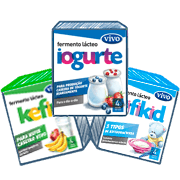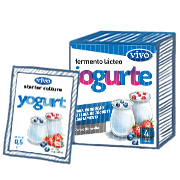
VIVO starter culture contains beneficial bacteria. These bacteria have several properties:
- They can ferment milk, turning it into a fermented dairy product.
- They have probiotic properties and help restore the gut microbiota.
- They inhibit the growth of many harmful microorganisms.
Starter cultures differ in the types of bacteria they contain. These differences affect:
- Preparation time and temperature.
- The taste and texture of the finished product.
- The product’s dietary, therapeutic, and preventive properties.
- The type of finished product, such as kefir or yogurt.
More information about starter cultures is available in the product catalog.
The VIVO group of companies was established in 2008 and specializes in producing and selling bacterial starter cultures for making fermented dairy products at home.
Thanks to their distinctive properties, quality, and safety, VIVO starter cultures are used by millions of people around the world.
VIVO starter cultures are widely popular in Ukraine, where they are market-leading products sold in major supermarkets and pharmacies across the country.
VIVO’s production facility is located in Brovary, Ukraine. The company has implemented international quality management and food safety systems. It uses bacterial cultures produced by leading companies in France, Germany, Italy, and Denmark as raw materials.
VIVO is committed to producing high-quality products. In 2014, the company received ISO 9001:2008 certification for its quality management system, as well as ISO 22000:2005 certification for its food safety management system.
The quality and safety of VIVO products have allowed the entire product range to be registered as special dietary foods and baby foods. VIVO starter cultures can be used by adults and children from 6 months of age.
Yogurt made with VIVO starter culture differs from commercially produced yogurt because it contains a large number of live, beneficial bacteria and no concentrates, flavorings, or other additives. It is an all-natural product that you can enjoy fresh.
Our yeast does not contain GMOs (genetically modified organisms). This fact is confirmed by relevant studies and documents.
Our company has sold millions of sachets of VIVO starter culture. Throughout our years of operation, no cases of food poisoning or other harmful health effects associated with the use of our products have been reported. This reflects the strong safety record of VIVO starter cultures.
Make sure the containers you use to prepare our products are clean. You should also consider any individual intolerance to dairy or fermented dairy products.
Yes! VIVO's entire production process is certified according to ISO 9001:2015 and 22000:2005 standards.
VIVO starter cultures have the following shelf life:
In the refrigerator (at +2°C to +8°C): 12 months.
Long-term studies have shown that the starter cultures remain stable despite temperature fluctuations during storage and transport.
Deviations from the recommended storage temperature are permitted for up to 10 days during transport.
Our products are delivered to logistics providers, where they are stored at a temperature no higher than 8°C.
Long-term studies have shown that starter cultures remain stable despite temperature fluctuations during storage and transport.
It is recommended that the finished fermented dairy product be stored in the refrigerator for a maximum of 5 days.
The composition is a complex of live bacteria. Its bacterial composition varies depending on the type of starter culture.
One sachet of the LIVE starter culture is designed for use with 1 to 3 liters of milk.
No. The yeast cannot be stored after the sachet is opened.
If the yogurt is runny, it has not fermented enough. This may be due to a low fermentation temperature, insufficient fermentation time, or the mixture cooling during fermentation.
If the yogurt is still runny, we recommend leaving it in a warm place for a few more hours to finish fermenting.
This is a sign that the product has fermented for too long. It can happen if the fermentation temperature is too high or the fermentation time is too long. The yogurt retains its beneficial properties; the main difference is that it may taste very sour.
Yes, this yogurt is no worse than the regular kind in terms of its properties; the only difference is that it might be more tart.
The product has fermented for too long. Reduce the fermentation temperature or shorten the fermentation time.
This yogurt has the same properties as usual; the only difference is that it may taste more sour.
Yes, you can. But only for the finished product.
After the yogurt cools, it should be stirred thoroughly. The more you stir it, the more fluid the yogurt will become.
All VIVO products can be taken daily.
Yogurt and other fermented dairy products can be consumed at any time of day and included in the daily diet.
The fat content of the finished yogurt will correspond exactly to the fat content of the milk used to make the yogurt.
These values will correspond exactly to those of the milk used to make the yogurt.
No.
No, they cannot. Allergies can only be caused by an individual intolerance to lactose or cow's milk protein.
You can eat them as a daily meal. There is no need to take breaks.
The perfect choice:

- Real yogurt, without
additives. - Ensures good digestion.
- Strengthens immunity.


- Classic kefir made with your own hands.
- Improves metabolism.
- Helps eliminate excess weight.

- Healthy food for children from 2 years of age.
- Restores the intestinal flora.
- Normalizes digestion.
DISCOVER MORE ABOUT VIVO PRODUCTS